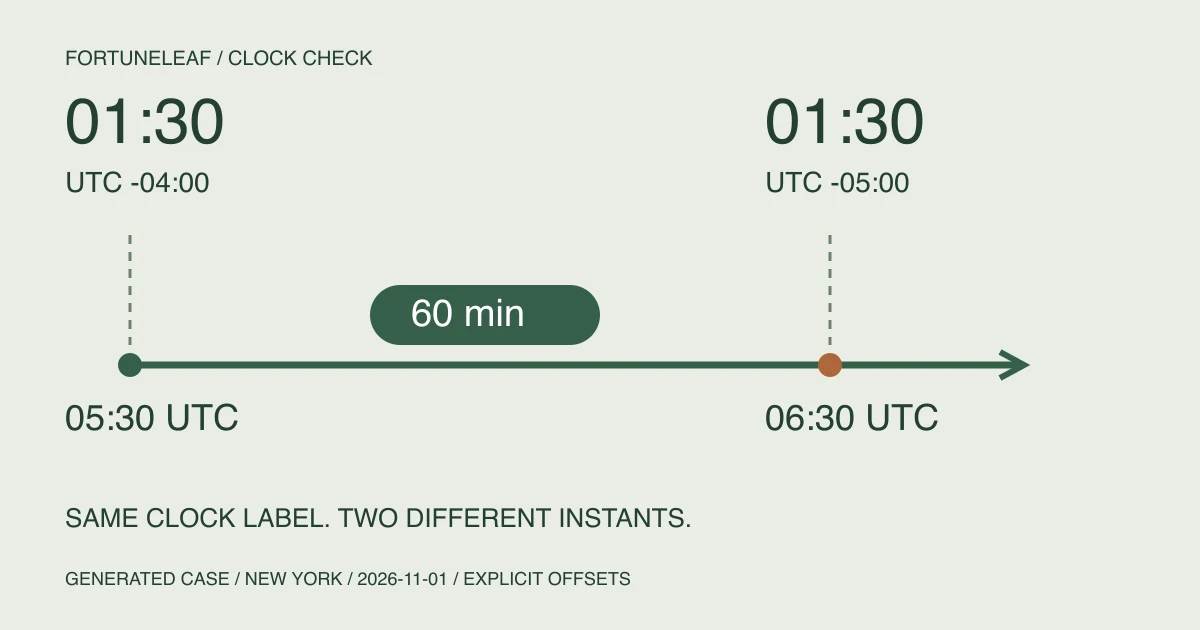
Two entries both say 01:30 on November 1, 2026, in New York. Subtracting the clock labels gives zero. If the first is 01:30 at UTC−04:00 and the second is 01:30 at UTC−05:00, sixty minutes have passed. The missing information is which occurrence of 01:30 each entry means.
We generated seven cases and ran a Python check, then compared every result with the JavaScript module used by the calculator below. These are constructed examples, not recordings from someone's calendar. We did not measure a scheduling benefit or test a calendar provider.
Keep three numbers separate
A clock-label difference compares the written dates and times without their UTC offsets. An offset change compares the end offset with the start offset. Elapsed time is the first number minus the second. Both dates matter; crossing midnight is not a reason to discard the end date.
For the repeated 01:30, the clock difference is 0. The offset change is −300 − (−240) = −60 minutes. The elapsed time is therefore 0 − (−60) = 60. In UTC, the endpoints are 05:30 and 06:30. This is a change of representation, not a second hour added by software.
| Generated case | Written start and end | Clock difference | Elapsed |
|---|---|---|---|
| New York spring | Mar 8, 01:30 −05:00 → 03:30 −04:00 | 120 min | 60 min |
| New York autumn span | Nov 1, 00:30 −04:00 → 02:30 −05:00 | 120 min | 180 min |
| Repeated New York hour | Nov 1, 01:30 −04:00 → 01:30 −05:00 | 0 min | 60 min |
| Seoul midnight | Oct 24, 23:30 +09:00 → Oct 25, 00:30 +09:00 | 60 min | 60 min |
| Seoul and UTC labels | Oct 25, 09:00 +09:00 → Oct 25, 00:00 +00:00 | −540 min | 0 min |
| Ordinary Seoul hour | Oct 25, 09:00 +09:00 → 10:00 +09:00 | 60 min | 60 min |
| Kathmandu and UTC labels | Oct 25, 09:00 +05:45 → 03:30 +00:00 | −330 min | 15 min |
All dates in this table are in 2026. The negative clock-label differences are comparisons of differently labelled clocks; they are not negative elapsed durations. A whole-hour offset assumption would also lose the Kathmandu example's fifteen-minute result.
Change one offset and inspect the UTC endpoints
The following calculator starts with a generated example. Choose another example or edit the four fields. Keep the dates and both offsets visible when sharing a calculation. The result is only an arithmetic comparison of the supplied values. It does not identify a city or decide whether those values describe a valid local time there.
Compare clock labels with elapsed time
Inputs are calculated on this page without saving or transmission. This does not validate a region’s actual daylight-saving rules.
For a useful check, select the repeated-hour case and change the end offset from −05:00 to −04:00. The elapsed result changes from 60 to 0 because both endpoints now describe the same instant. Restore the preset before moving to the next example. No meeting was moved; only the constructed input changed.
Why the Python subtraction needs an explicit question
Our regional inputs use Python's ZoneInfo. Its fold value distinguishes the two occurrences of an ambiguous local time. The zoneinfo documentation explains which side of a transition fold selects. The program requires that choice instead of silently accepting the first occurrence.
An important trap appeared in the generated cases: subtracting two Python datetimes with the same tzinfo object follows their clock labels. The repeated-hour example returns zero by that operation. The datetime subtraction rules document this behavior. It is not a failed Python test. We convert both endpoints to UTC before subtracting when the question is elapsed time, obtaining 60 minutes, and preserve both results in the JSON.
A valid offset is not proof that the local time exists
The regional check also tries New York at 02:30 on March 8, 2026. Converting that candidate to UTC and back does not return the requested local time, so our program rejects it. It separately rejects the repeated autumn time without a fold choice. The browser calculator has no regional timezone database lookup: entering a plausible date and offset can produce arithmetic even when the corresponding local time is invalid in a particular city.
For a real invitation, obtain its date, regional timezone and unambiguous endpoint from the calendar provider or organiser. Do not guess an offset from the country's name. IANA's timezone database changes when authorities change rules. Our run records hashes of the installed zone files; it is not certification that every device has the newest global rules. Future invitations should be rechecked if rules change.
What should I copy into an invitation?
Keep the date, the regional timezone and an unambiguous occurrence of the local time together. For the generated repeated-hour example, “November 1 at 01:30” is incomplete; the first occurrence is 05:30 UTC and the second is 06:30 UTC. An invitation that contains only the clock label leaves the question unanswered.
Start with the organiser's specified timezone, check both endpoints, and compare their UTC values. If an endpoint is in a skipped hour or the occurrence is unclear, ask for clarification before calculating. Do not fix an invalid local time by guessing an offset. The example selector can reproduce the arithmetic, but it cannot validate a real invitation for a city.
Does “every week at 09:00” mean every 168 hours?
Only while the relevant UTC offset stays unchanged. Start in New York on March 1, 2026, at 09:00, or 14:00 UTC. The next Sunday at 09:00 is March 8 at 13:00 UTC: 167 hours later. Add exactly 168 hours instead, and the next local start is 10:00. In our autumn example, keeping 09:00 gives 169 hours between starts; keeping 168 hours moves the clock label to 08:00. Neither rule is inherently wrong. They preserve different things.
For a weekly conversation tied to an organiser's working morning, the regional clock may be the intended condition. For an elapsed-time process, the fixed interval may matter instead. State which condition you need before entering the recurrence. An offset such as −05:00 identifies a difference from UTC at one point; it does not carry New York's future transition rules. Nor does “everywhere at 09:00” necessarily invite people to one shared instant.
We added eight generated series with four accepted starts under each rule. The comparison includes ordinary New York weeks, spring and autumn changes, unchanged Seoul offsets, a missing start, both occurrences of a repeated start, and a half-hour change in Lord Howe. Open the rows to see the actual dates; do not assume every transition changes an hour.
Start: March 1, 09:00 (−05:00) / 14:00 UTC
Open a generated case to compare dates, UTC starts and spacing. These tables work without JavaScript.
New York: an ordinary week
America/New_York · Repeated-time choice: first · Skip missing local candidates; count four accepted starts.
| Local date, time and offset | UTC | Since previous start |
|---|---|---|
| 2026-02-01 09:00 (−05:00) | 2026-02-01 14:00Z | First start |
| 2026-02-08 09:00 (−05:00) | 2026-02-08 14:00Z | 168 h |
| 2026-02-15 09:00 (−05:00) | 2026-02-15 14:00Z | 168 h |
| 2026-02-22 09:00 (−05:00) | 2026-02-22 14:00Z | 168 h |
New York: spring, 09:00
America/New_York · Repeated-time choice: first · Skip missing local candidates; count four accepted starts.
| Local date, time and offset | UTC | Since previous start |
|---|---|---|
| 2026-03-01 09:00 (−05:00) | 2026-03-01 14:00Z | First start |
| 2026-03-08 09:00 (−04:00) | 2026-03-08 13:00Z | 167 h |
| 2026-03-15 09:00 (−04:00) | 2026-03-15 13:00Z | 168 h |
| 2026-03-22 09:00 (−04:00) | 2026-03-22 13:00Z | 168 h |
| Local date, time and offset | UTC | Since previous start |
|---|---|---|
| 2026-03-01 09:00 (−05:00) | 2026-03-01 14:00Z | First start |
| 2026-03-08 10:00 (−04:00) | 2026-03-08 14:00Z | 168 h |
| 2026-03-15 10:00 (−04:00) | 2026-03-15 14:00Z | 168 h |
| 2026-03-22 10:00 (−04:00) | 2026-03-22 14:00Z | 168 h |
New York: autumn, 09:00
America/New_York · Repeated-time choice: first · Skip missing local candidates; count four accepted starts.
| Local date, time and offset | UTC | Since previous start |
|---|---|---|
| 2026-10-25 09:00 (−04:00) | 2026-10-25 13:00Z | First start |
| 2026-11-01 09:00 (−05:00) | 2026-11-01 14:00Z | 169 h |
| 2026-11-08 09:00 (−05:00) | 2026-11-08 14:00Z | 168 h |
| 2026-11-15 09:00 (−05:00) | 2026-11-15 14:00Z | 168 h |
| Local date, time and offset | UTC | Since previous start |
|---|---|---|
| 2026-10-25 09:00 (−04:00) | 2026-10-25 13:00Z | First start |
| 2026-11-01 08:00 (−05:00) | 2026-11-01 13:00Z | 168 h |
| 2026-11-08 08:00 (−05:00) | 2026-11-08 13:00Z | 168 h |
| 2026-11-15 08:00 (−05:00) | 2026-11-15 13:00Z | 168 h |
Seoul: unchanged offset
Asia/Seoul · Repeated-time choice: first · Skip missing local candidates; count four accepted starts.
| Local date, time and offset | UTC | Since previous start |
|---|---|---|
| 2026-03-01 09:00 (+09:00) | 2026-03-01 00:00Z | First start |
| 2026-03-08 09:00 (+09:00) | 2026-03-08 00:00Z | 168 h |
| 2026-03-15 09:00 (+09:00) | 2026-03-15 00:00Z | 168 h |
| 2026-03-22 09:00 (+09:00) | 2026-03-22 00:00Z | 168 h |
New York: a missing 02:30
America/New_York · Repeated-time choice: first · Skip missing local candidates; count four accepted starts.
Skipped candidate: 2026-03-08T02:30
| Local date, time and offset | UTC | Since previous start |
|---|---|---|
| 2026-03-01 02:30 (−05:00) | 2026-03-01 07:30Z | First start |
| 2026-03-15 02:30 (−04:00) | 2026-03-15 06:30Z | 335 h |
| 2026-03-22 02:30 (−04:00) | 2026-03-22 06:30Z | 168 h |
| 2026-03-29 02:30 (−04:00) | 2026-03-29 06:30Z | 168 h |
| Local date, time and offset | UTC | Since previous start |
|---|---|---|
| 2026-03-01 02:30 (−05:00) | 2026-03-01 07:30Z | First start |
| 2026-03-08 03:30 (−04:00) | 2026-03-08 07:30Z | 168 h |
| 2026-03-15 03:30 (−04:00) | 2026-03-15 07:30Z | 168 h |
| 2026-03-22 03:30 (−04:00) | 2026-03-22 07:30Z | 168 h |
New York: first 01:30
America/New_York · Repeated-time choice: first · Skip missing local candidates; count four accepted starts.
| Local date, time and offset | UTC | Since previous start |
|---|---|---|
| 2026-10-25 01:30 (−04:00) | 2026-10-25 05:30Z | First start |
| 2026-11-01 01:30 (−04:00) | 2026-11-01 05:30Z | 168 h |
| 2026-11-08 01:30 (−05:00) | 2026-11-08 06:30Z | 169 h |
| 2026-11-15 01:30 (−05:00) | 2026-11-15 06:30Z | 168 h |
| Local date, time and offset | UTC | Since previous start |
|---|---|---|
| 2026-10-25 01:30 (−04:00) | 2026-10-25 05:30Z | First start |
| 2026-11-01 01:30 (−04:00) | 2026-11-01 05:30Z | 168 h |
| 2026-11-08 00:30 (−05:00) | 2026-11-08 05:30Z | 168 h |
| 2026-11-15 00:30 (−05:00) | 2026-11-15 05:30Z | 168 h |
New York: second 01:30 (custom choice)
America/New_York · Repeated-time choice: second · Skip missing local candidates; count four accepted starts.
| Local date, time and offset | UTC | Since previous start |
|---|---|---|
| 2026-10-25 01:30 (−04:00) | 2026-10-25 05:30Z | First start |
| 2026-11-01 01:30 (−05:00) | 2026-11-01 06:30Z | 169 h |
| 2026-11-08 01:30 (−05:00) | 2026-11-08 06:30Z | 168 h |
| 2026-11-15 01:30 (−05:00) | 2026-11-15 06:30Z | 168 h |
| Local date, time and offset | UTC | Since previous start |
|---|---|---|
| 2026-10-25 01:30 (−04:00) | 2026-10-25 05:30Z | First start |
| 2026-11-01 01:30 (−04:00) | 2026-11-01 05:30Z | 168 h |
| 2026-11-08 00:30 (−05:00) | 2026-11-08 05:30Z | 168 h |
| 2026-11-15 00:30 (−05:00) | 2026-11-15 05:30Z | 168 h |
Lord Howe: a 30-minute change
Australia/Lord_Howe · Repeated-time choice: first · Skip missing local candidates; count four accepted starts.
| Local date, time and offset | UTC | Since previous start |
|---|---|---|
| 2026-09-27 09:00 (+10:30) | 2026-09-26 22:30Z | First start |
| 2026-10-04 09:00 (+11:00) | 2026-10-03 22:00Z | 167.5 h |
| 2026-10-11 09:00 (+11:00) | 2026-10-10 22:00Z | 168 h |
| 2026-10-18 09:00 (+11:00) | 2026-10-17 22:00Z | 168 h |
| Local date, time and offset | UTC | Since previous start |
|---|---|---|
| 2026-09-27 09:00 (+10:30) | 2026-09-26 22:30Z | First start |
| 2026-10-04 09:30 (+11:00) | 2026-10-03 22:30Z | 168 h |
| 2026-10-11 09:30 (+11:00) | 2026-10-10 22:30Z | 168 h |
| 2026-10-18 09:30 (+11:00) | 2026-10-17 22:30Z | 168 h |
What happens when a weekly start is missing or repeated?
Our weekly 02:30 New York series begins on March 1. March 8 has no 02:30, so the local-rule comparison skips that candidate. Its next accepted start is March 15 at 02:30; four accepted starts extend through March 29. The gap between the first two accepted starts is 335 hours. Skipping an occurrence is not the same as rescheduling it to 03:30. The fixed-168-hour sequence has no missing instant and displays 03:30 on March 8.
RFC 5545 section 3.3.10 distinguishes recurrence candidates that do not exist from accepted occurrences: the missing candidates are left out of the count. Its date-time rules in section 3.3.5 select the first occurrence when a local label repeats. A standalone missing DATE-TIME has a different interpretation there; do not generalise our recurrence skip policy to every field in a calendar file.
For November 1 at 01:30, the first New York occurrence is 05:30 UTC; the second is 06:30 UTC. Both comparison rows are available, but the second-occurrence row is a separately chosen policy, not an equivalent standard weekly rule. If a real organiser wants the second occurrence or a replacement for a missing start, confirm that exception explicitly in the actual service. We have not tested Google, Apple or Outlook imports, and this example does not export an ICS file.
Finish the invitation before checking the day's gaps
Download the blank weekly invitation note. Write the fixed condition, regional timezone, first local and UTC start, missing/repeated-time handling, and end date or count. Verify the two starts around a transition in the calendar service you will actually use. Duration is a separate question: 167 hours between two meeting starts does not make either meeting last 167 hours.
The weekly Python source, 64 occurrence rows and complete checks are available to inspect. Run python3 recurrence-check.py with Python 3.9 or later and installed timezone data. Eight series matched specified interval totals and second UTC endpoints; all 48 adjacent intervals also matched a calculation from the printed offsets. Ten deliberately invalid or unresolved inputs were rejected as expected. These are finite checks written by the same author, not independent certification or tests of a calendar provider. Zone-file hashes identify the data used; future regional rules can change.
After resolving the starts and ends, use the separate day-occupancy calculation to find collisions. Resolving a recurrence and merging its actual intervals answer different questions; the order matters.
Reproduce the checks without a private calendar
The Python source, generated CSV, complete results and browser module are public. The Python version needs Python 3.9 or later and available system timezone data. If your environment lacks that data, the table and explicit-offset calculator remain usable without installing anything for this article.
Seven valid cases matched the specified totals. The builder additionally ran the actual browser module's seven presets against the Python outputs. Six regional/input cases were deliberately rejected: a nonexistent time, an ambiguous time without its occurrence, an invalid date, an invalid fold, a missing offset and reversed UTC endpoints. These are successful rejection checks, not failed meetings or Google decisions. The same author produced both implementations; cross-checks are not independent expert review.
The explicit-offset calculator is minute-precision and excludes leap seconds and recurrence expansion. The separate weekly comparison above expands only its declared weekly cases, not arbitrary recurrence rules. Neither imports calendars or optimises a schedule. To combine several appointments after resolving their endpoints, continue with the separate overlap and occupancy calculation; adding event lengths still does not remove collisions.